
Are you familiar with the power berry Aronia? This small berry holds true diversity. Visually, it radiates in a beautiful red to berry-like purple. It captivates not only with its color but also bursts with valuable ingredients that are interesting in many respects, which is why Aronia is used in various areas.
The superfruit is best known in the food sector. It is mostly available as dried berries or as juice. Aronia melanocarpa – also known as Black Chokeberry – has made its way onto supermarket shelves in recent years. It is a common ingredient in muesli, jams, or even juices.
But why is the dark purple berry considered a superfood? It owes this primarily to its high content of polyphenols in the form of anthocyanins. Polyphenols are secondary plant compounds that perform various important functions in the plant. Due to their color, they can protect against predators, attract insects for pollination, or protect the plant from free radicals due to their antioxidant properties.
In scientific studies, polyphenols were investigated in more detail, and these bioactive plant compounds were shown to have antioxidant and anti-inflammatory properties. Much indicates that polyphenolic compounds such as anthocyanins, flavonoids, and procyanidins can thus have positive effects on cardiovascular diseases, metabolism, gut flora, and the immune system. Research into this is in full swing.
Aronia - Superfood with Tradition
The origin of the Aronia berry lies in North America. When the indigenous tribes of this region discovered the red berries as food and medicine long before us, they naturally knew nothing yet about the health-promoting properties of the polyphenols they contained. From historical documents, we know that the Potawatomi tribe used the berry to treat colds. Aronia was also often found in one of the most important traditional foods of Native Americans, pemmican. This was an extremely energy-rich winter and travel ration made from dried meat, melted fat, and dried berries, which ensured the tribes' survival under harsh conditions.
At the beginning of the 20th century, Aronia came to Russia with a Russian plant breeder, was cultivated there on a large scale, and finally recognized as a cultivated plant. After Russian researchers discovered the high antioxidant power of the Aronia berry, it was declared a medicinal plant in the 1970s. Today, the superfood berry is also cultivated in Central Europe and appreciated as a food. Meanwhile, it is gladly used in various areas of life for internal or external application.
Aronia as a Power Ingredient in Skincare
This plant extract can also unleash its positive effects in skincare. Those who have been following my blog for a while know that studies dealing with antioxidants are of particular interest to us as skincare experts. These radical scavengers are simply essential when it comes to protecting the skin from oxidative stress from the outside.
In the Aronia berry, antioxidants are contained in the form of polyphenols, specifically anthocyanins. In this regard, the Aronia berry is something very special. It has an exceptionally high content of anthocyanins and other polyphenols. Studies have shown that Aronia therefore has one of the highest antioxidant capacities compared to other fruits and berries. A berry with a powerful effect, whose extract has now also been used as an innovative ingredient in care products for several years. Especially for skincare developed for protection against premature skin aging, Aronia provides the ideal active ingredient. In the INCI, an Aronia extract can be found under the designation "Aronia Melanocarpa Fruit Extract".
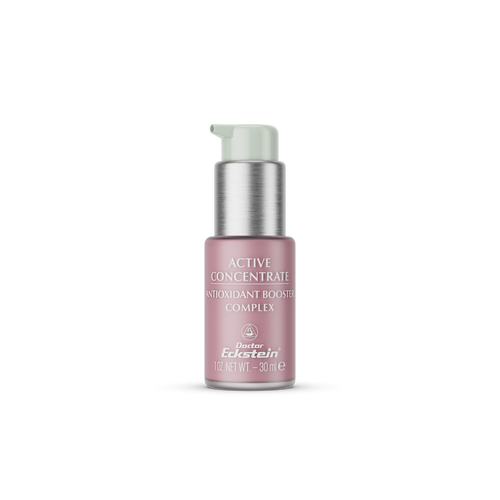
Depending on how much Aronia in the form of an extract is in the care product, the product can take on a "berry" color. This also gives the skin a fresh and rosy complexion. Curious? Then try our new skincare serum AC ANTIOXIDANT BOOSTER COMPLEX. In addition to other antioxidants, it contains an Aronia fruit extract and supports your skin's natural resistance. I use the serum daily and look forward to its subtly berry-fruity scent every day.
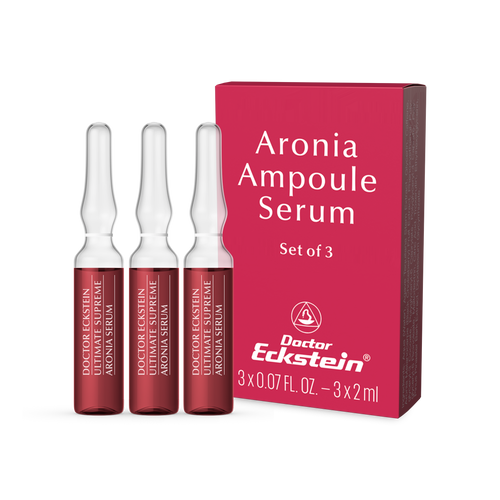
Feel free to also try our ARONIA AMPOULE SERUM. This bright red serum is also rich in antioxidants and supports the skin in defending against free radicals. Both products can be used as an additional add-on under your day cream.
Fitting the topic of additional skin protection and thus preventive care against "premature skin aging," you can find more in my blog post: As Skin Ages.
And if you want to learn more about antioxidants and their effects, feel free to read on here: Why antioxidants are amazing.
Your Verena Eckstein
Scientific literature
Di Lorenzo C. et al (2021). Polyphenols and Human Health: The Role of Bioavailability. Nutrients Jan 19;13(1):273. DOI: 10.3390/nu13010273.
Kokotkiewicz, A. et al. (2010). Aronia Plants: A Review of Traditional Use, Biological Activities, and Perspectives for Modern Medicine. Journal of Medicinal Food, 13(2), 255–269. DOI: 10.1089/JMF.2009.0062
Kulling S. E., Rawel H. M. (2008). Chokeberry (Aronia melanocarpa) – A Review on the Characteristic Components and Potential Health Effects. Planta Med. Oct;74(13):1625-34.
DOI: 10.1055/s-0028-1088306.
Proteggente A. R. et al (2022). The antioxidant activity of regularly consumed fruit and vegetables reflects their phenolic and vitamin C composition. Free Radic Res Feb;36(2):217-33. DOI: 10.1080/10715760290006484.
Ren Y. et al. (2022). Potential Benefits of Black Chokeberry (Aronia melanocarpa) Fruits and Their Constituents in Improving Human Health. Molecules 13;27(22):7823. DOI: 10.3390/molecules27227823.