
Vitamin C: The daily boost for you and your skin
As soon as you mention Vitamin C, everyone immediately thinks of bright yellow lemons or boosting the immune system to fight off a cold.
But for skincare? Vitamin C has been celebrating a triumphant march through bathrooms, cosmetic shelves, and even professional salons for years. But what is the hype about Vitamin C? Does applying it to the skin have the same benefits as drinking a hot lemon water?
The chemistry behind Vitamin C
Vitamin C is another term for ascorbic acid, which is a water-soluble, essential vitamin. What most people don't know is that, chemically speaking, there are actually 4 different variants of Vitamin C. However, only L-(+)-ascorbic acid is biologically effective, meaning it is relevant for metabolism. This is rarely used in cosmetics, however, as it generally does not remain stable enough in cosmetic formulations. For this reason, derivatives are used, such as Ascorbyl Glucoside, Ascorbyl Phosphate, or Ascorbyl Tetraisopalmitate. These more stable variants are precursors to ascorbic acid and are converted into active ascorbic acid (i.e., Vitamin C) after being applied to the skin. These derivatives are often marketed in cosmetics under the collective term "Vitamin C." The substances can also exert the effects of ascorbic acid, but this does not happen immediately because a conversion process must first take place.
A fairly high content of Vitamin C can be found in various plants. It occurs in citrus fruits, acerola, or rose hips – and surprisingly, also in potatoes and sauerkraut.
Fun fact: Sauerkraut (15–30mg per 100g) and potatoes (17mg per 100g) sometimes contain more Vitamin C than an apple (5–30mg per 100g).
Vitamin C in our body
Except for the sunshine vitamin Vitamin D, the human body is unable to produce vitamins itself, which is why they usually have to be supplied through food. For Vitamin C, we lack the enzyme L-gulonolactone oxidase. However, we need Vitamin C to produce the enzyme prolyl hydroxylase, which ultimately synthesizes the protein collagen. Collagen is responsible for the structure and thus the stability of our connective tissue, bones, blood vessels, and also our dentin.
Unlike humans, some animals, such as dogs, cats, and horses, are capable of producing Vitamin C themselves.
Vitamin C deficiency
You have surely heard of the seafaring disease scurvy. This arises from a lack of Vitamin C. In the past, it was the most common cause of death among sailors. In history, reports of it date back as far as the Crusades. Over a period of about 2–4 months without Vitamin C, various physical deficiency symptoms occur because the necessary collagen can no longer be produced. Typical symptoms range from joint pain, tooth loss, and skin hemorrhages to a weakened immune system, and can even be fatal if left untreated.
Although it was discovered much later, after centuries of research, that a Vitamin C deficiency was responsible for this, sailors began taking various durable, Vitamin C-rich foods on their voyages. Onions, potatoes, sauerkraut, citrus fruits, or even acerola berries were brought on board. With timely intake of Vitamin C, the consequences of scurvy can even be partially alleviated and reversed.
Vitamin C in food
Vitamin C is also used in food to keep it stable for a longer period. In the list of ingredients, it can be found as E300; the derivatives are E301 and E302. Since it also acts as an antioxidant, it is often simultaneously a color stabilizer in a multitude of food preparations. For example, it prevents cut fruit from turning brown as well as sausage from spoiling.
The strengthening effect on the immune system should also not be overlooked; a warming hot lemon water works wonders.
Vitamin C in cosmetics
In cosmetics, Vitamin C has gained importance in recent years. As a result, a large number of products containing Vitamin C and its derivatives have come onto the market.
The effect and intensity depend heavily on various factors. Every derivative has a different release time in the body, which also depends on the respective base (emulsion, water, or gel). The concentration used as well as the pH value also play a decisive role.
Generally speaking, in addition to its strong antioxidant effect, Vitamin C and its derivatives have many other benefits for the skin.
They can:
- Protect against UV-induced skin damage
- Reduce wrinkles in photo-aged skin
- Have a skin-lightening effect
- Improve the complexion in cases of blemishes and acne
- Increase skin relief density
- Reduce body odor
- Strengthen skin structure -> improve elasticity
- Support collagen synthesis
As you can see, Vitamin C not only has positive effects on us in food, but it can also do a lot in cosmetic products.
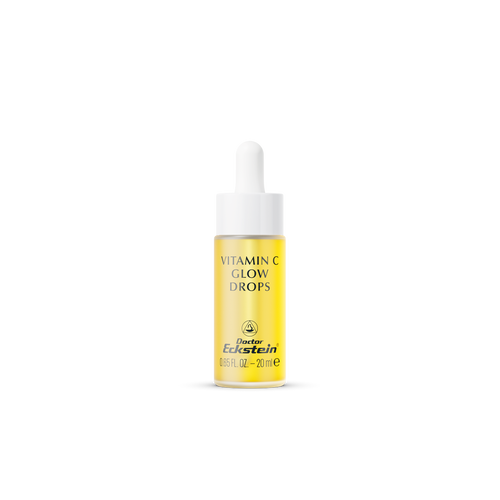
In our VITAMIN C GLOW DROPS, we use Vitamin C Phosphate, as this is more stable in the formulation and, due to the delayed conversion into ascorbic acid, more gentle on the skin. In the list of ingredients, you will find it listed as Sodium Ascorbyl Phosphate.
Feel free to test our new VITAMIN C GLOW DROPS and convince yourself of the new radiance of your skin!
Yours, Verena Eckstein
Scientific literature:
GdCh, Data sheets for the evaluation of the efficacy of active ingredients in cosmetic products – Vitamin C
FAQ Vitamin C, BfR, 1-7, (2026) Scurvy – a now forgotten common disease, Heinz Flamm, Wien Med Wochenschr (2025) 175:75–97.
Of sailors, guinea pigs, and citrus fruits, S. Streller, K. Roth, Chem. Unserer Zeit, 2009, 43, 38 – 54.
Sodium ascorbyl phosphate shows in vitro and in vivo efficacy in the prevention and treatment of acne vulgaris, J. Klock et al., International Journal of Cosmetic Science, 2005, 27, 171–176.
The Roles of Vitamin C in Skin Health, Juliet M. Pullar et al., Nutrients 2017, 9, 866.